Loading...
Back to Articles
Lawn Turning Brown in Spots Jacksonville: Diagnose & Fix
Lawn Care January 27, 2026 8 min read
For current costs, compare the exact product or written project scope. See what to include in a sod estimate; this guide does not establish a current price, saving or resale return.
You walk outside and there's a brown patch in your lawn that wasn't there last week. Or maybe you've got multiple brown spots scattered across the yard, some growing larger by the day. Your neighbor's lawn looks fine, your irrigation seems to be working, but your grass is dying in irregular patches.
Apply the wrong treatment and you waste time and money while the problem gets worse.
I've diagnosed brown spot problems in hundreds of Jacksonville yards, and the pattern is usually the same: homeowners see brown grass and immediately think they need to water more or fertilize. Half the time, more water or fertilizer makes the problem worse because those weren't the actual issues.
Here's how to figure out what's killing your grass and fix it correctly.
Start with Pattern Recognition
Before you do anything else, look at the pattern of brown spots. This gives you important diagnostic clues.
Irregular Patches That Spread
Likely cause: Fungal disease
Brown patch, gray leaf spot, and other fungal diseases create irregular patches that expand outward. The grass inside the patch turns tan or brown, and you might see a darker "smoke ring" at the leading edge early in the morning.
Fungal diseases love Jacksonville's summer conditions—hot temperatures combined with high humidity and frequent rain create perfect conditions.
Circular Spots Near Trees or Obstacles
Likely cause: Irrigation coverage gaps
If brown spots appear in consistent locations, especially in corners or near trees, you've probably got areas the sprinklers aren't reaching.
The pattern stays the same week to week, and the brown areas have distinct edges where coverage stops.
Spots Along Driveway or Street
Likely cause: Salt damage or reflected heat
Grass along paved surfaces gets extra stress from heat reflection and, near streets, salt spray from passing vehicles. Brown strips parallel to hardscaping suggest environmental stress.
Random Small Circles
Likely cause: Dog urine
Female dogs create circular brown spots surrounded by a ring of dark green grass (from nitrogen in urine). The spots appear randomly wherever the dog chooses to urinate.
Male dogs typically urinate on vertical objects (trees, posts), which causes different damage patterns.
Yellowing That Turns Brown
Likely cause: Chinch bugs or other insects
Insect damage often starts as yellowing that progresses to brown. Patches begin small and expand as the insect population grows. You'll often see the most damage in the hottest, sunniest areas.
Diagnosing the Specific Problem
Once you've identified the pattern, get down and actually examine the brown grass.
Check for Fungal Disease
What to look for:
- Leaf blades with tan spots or lesions
- Dark "smoke ring" at the edge of brown patches (early morning)
- Grass that pulls up easily (roots are dead)
- Slimy or greasy texture on grass blades
The float test: Pull up a sample of brown grass. If the roots are brown, mushy, or nonexistent, fungus has likely destroyed the root system. Healthy roots are white or light tan.
When it happens: Fungal problems in Jacksonville peak during the rainy season (June-September) when conditions are warm and humid. Some fungal diseases also appear in spring if we get extended periods of wet weather.
Check for Chinch Bugs
Chinch bugs are tiny insects (1/6 inch long) that suck sap from grass blades. They're incredibly common in Jacksonville St. Augustine lawns.
The coffee can test:
- Cut both ends off a coffee can or large plastic cup
- Push one end into the soil at the edge of a brown patch (where brown meets green)
- Fill with water and maintain the water level for 5-10 minutes
- Watch for chinch bugs floating to the surface
Adult chinch bugs are black with white wings. Nymphs are smaller and reddish.
You might also see them by parting the grass at the base and looking at the soil and thatch layer. They move quickly.
When it happens: Chinch bug damage peaks in Jacksonville during hot, dry periods (April-June and September-October). They thrive in sunny areas and stressed lawns.
Check Irrigation Coverage
The can test:
- Place several straight-sided containers (tuna cans work) at various points in your lawn
- Run the irrigation zone for 15 minutes
- Measure water depth in each can
You should see relatively consistent amounts (within 25%). If some cans have much less water, you've got coverage problems.
Also watch the system run. Look for:
- Sprinkler heads that don't pop up fully
- Heads spraying at odd angles
- Clogged nozzles producing weak streams
- Dead zones between heads
When it happens: Irrigation problems show up most during dry periods when the lawn depends on supplemental water. In Jacksonville, this is typically late April through early June before the rainy season.
Check Soil Moisture
Push a screwdriver into the soil in brown areas and green areas.
Healthy soil: The screwdriver slides in relatively easily to 4-6 inches.
Dry soil: The screwdriver barely penetrates or stops at 1-2 inches.
Saturated soil: Water pools in the hole, soil is muddy.
Both extremes cause brown spots. Dry soil stresses grass. Saturated soil suffocates roots and promotes disease.
Look for Grubs
Grubs (beetle larvae) feed on grass roots. Damage looks similar to drought stress but doesn't improve with watering.
Check for grubs:
- Use a shovel to cut a square foot section of turf
- Peel back the sod
- Examine the soil surface for white, C-shaped larvae
Threshold: 5-10 grubs per square foot causes noticeable damage. More than 10 requires treatment.
When it happens: Grub damage appears in Jacksonville late summer through fall (August-October).
Test for Dog Urine
If you have dogs, this is easy to identify. Spots appear where the dog regularly urinates.
Fresh urine spots are dark green (nitrogen fertilizer effect). As salts accumulate, grass dies and turns brown. You'll see a brown center with dark green ring.
Fixing Fungal Disease
If you've confirmed fungal disease, here's what works:
Immediate Actions
Stop watering at night. Water early morning (4-8 AM) so grass blades dry during the day. Wet grass overnight promotes fungal growth.
Improve air circulation. Thin out shrubs near affected areas. Prune tree branches to increase light and airflow.
Reduce nitrogen. Excessive nitrogen creates lush, tender growth that's more susceptible to disease. Hold off on fertilizer until the disease is controlled.
Treatment Options
Fungicides: Broad-spectrum fungicides like azoxystrobin or propiconazole control most lawn fungal diseases. Follow label directions exactly. Most require 2-3 applications at 14-day intervals.
You can't cure grass that's already dead, but fungicide stops the spread and protects healthy grass.
Cultural practices: Often more important than fungicide. Fix the conditions that favor disease (excessive moisture, poor drainage, too much nitrogen) or it'll just come back.
Prevention
- Water deeply but infrequently (promotes deep roots)
- Mow at proper height (3.5-4 inches for St. Augustine)
- Remove thatch buildup if it exceeds 1/2 inch
- Ensure good drainage
- Apply fungicide preventatively in spring if you've had problems before
Treatment
Insecticides: Bifenthrin, permethrin, or lambda-cyhalothrin work on chinch bugs. Granular formulations are easier for homeowners to apply than liquids.
Apply to affected areas plus 10-15 feet beyond. Water in immediately after application.
Timing: Treat when you actually see bugs, not just brown grass. The coffee can test confirms active infestation.
Note: Jacksonville has restrictions on fertilizer and pesticide application during certain months. Check local ordinances.
Recovery
Chinch bugs don't kill grass as quickly as fungus. If you catch the problem early and roots are still alive, grass usually recovers once bugs are controlled.
Dead areas need reseeding or resodding.
Prevention
- Maintain healthy, vigorous turf (proper fertilization, irrigation, mowing)
- Reduce thatch
- Avoid water stress (chinch bugs prefer dry, stressed grass)
- Consider more resistant grass varieties (Floratam St. Augustine shows some resistance)
Fixing Irrigation Problems
If coverage gaps are causing brown spots, you need to adjust or repair the system.
Adjust Existing Heads
- Change nozzles to increase throw distance
- Reposition spray patterns
- Adjust rotor arcs to eliminate overlaps or gaps
Add Heads
If the zone is designed wrong and coverage gaps can't be fixed with adjustments, you may need to add sprinkler heads. This requires tapping into the existing lateral line and is best handled by irrigation professionals.
Increase Runtime
If coverage is adequate but water volume is insufficient, increase zone runtime. Use the can test to determine how long you need to run to deliver 1/2 to 3/4 inch of water.
Jacksonville typically needs 1-1.5 inches of water per week during dry periods. Adjust irrigation to supplement rainfall.
Immediate Repair
- Flush the spot with water immediately after the dog urinates (dilutes nitrogen and salts)
- For existing damage, water heavily to leach salts deeper into soil
- Reseed or resod dead patches
Long-Term Solutions
Training: Teach your dog to urinate in a designated area (mulch bed, gravel area) away from lawn.
Dietary supplements: Products claim to reduce urine damage. Results are inconsistent.
Watering: Some homeowners follow the dog around with a hose. This works but is impractical for most people.
Resistant grass: Tall fescue tolerates dog urine better than St. Augustine, but it's not ideal for Jacksonville's climate.
Acceptance: Small spots from occasional urination aren't worth fighting. Flush them when you can and reseed annually.
Treatment
Curative: Trichlorfon or carbaryl kill existing grubs quickly. Apply when grubs are present and active (late summer in Jacksonville).
Preventive: Imidacloprid or other long-residual products applied in spring prevent grub damage. This works if you've had grub problems historically.
Recovery
Light grub damage recovers once grubs are controlled and grass is watered. Severe damage requires resodding.
When Multiple Problems Occur
Sometimes brown spots result from multiple issues compounding each other:
- Drought stress weakens grass, making it susceptible to chinch bugs
- Poor drainage creates conditions for fungal disease
- Shallow roots (from frequent light watering) make grass vulnerable to stress
Address the primary cause first, then fix contributing factors.
Seasonal Considerations in Jacksonville
Spring (March-May):
- Fungal disease if conditions are wet
- Chinch bugs as temperatures warm
- Irrigation problems become apparent as rainfall decreases
Summer (June-August):
- Fungal disease peaks during rainy season
- Brown patch, gray leaf spot most common
- Excess water more common than drought
Fall (September-November):
- Chinch bugs if dry
- Grub damage appears
- Second fungal disease window if warm and wet
Winter (December-February):
- Cold damage (rare but possible)
- Dormant grass can look brown (normal for Bahia, less common for St. Augustine)
- Minimal active pest or disease problems
When to Call a Professional
DIY diagnosis works for straightforward cases, but call a professional if:
- You can't identify the cause after examining patterns and testing
- Damage spreads rapidly despite treatment
- Multiple issues are present
- The problem recurs seasonally despite your efforts
- You need confirmation before investing in expensive treatment
Many local extension offices offer diagnostic services. Bringing in a sample of affected grass (with roots and soil attached) helps them identify the problem.
The Bottom Line
Brown spots in Jacksonville lawns have specific causes that require specific solutions. The pattern, timing, and appearance of damage points you toward the right diagnosis.
Take time to actually examine the grass, run simple tests, and confirm what's happening before throwing products at the problem.
Most brown spot problems in Jacksonville are fixable once you know what you're dealing with. Address the root cause, not just the symptoms, and your lawn recovers.
Need Professional Sod Installation?
Jax Sod provides sod installation, sod replacement, and new lawn installation across Jacksonville and Northeast Florida. Free quotes!
Related Articles
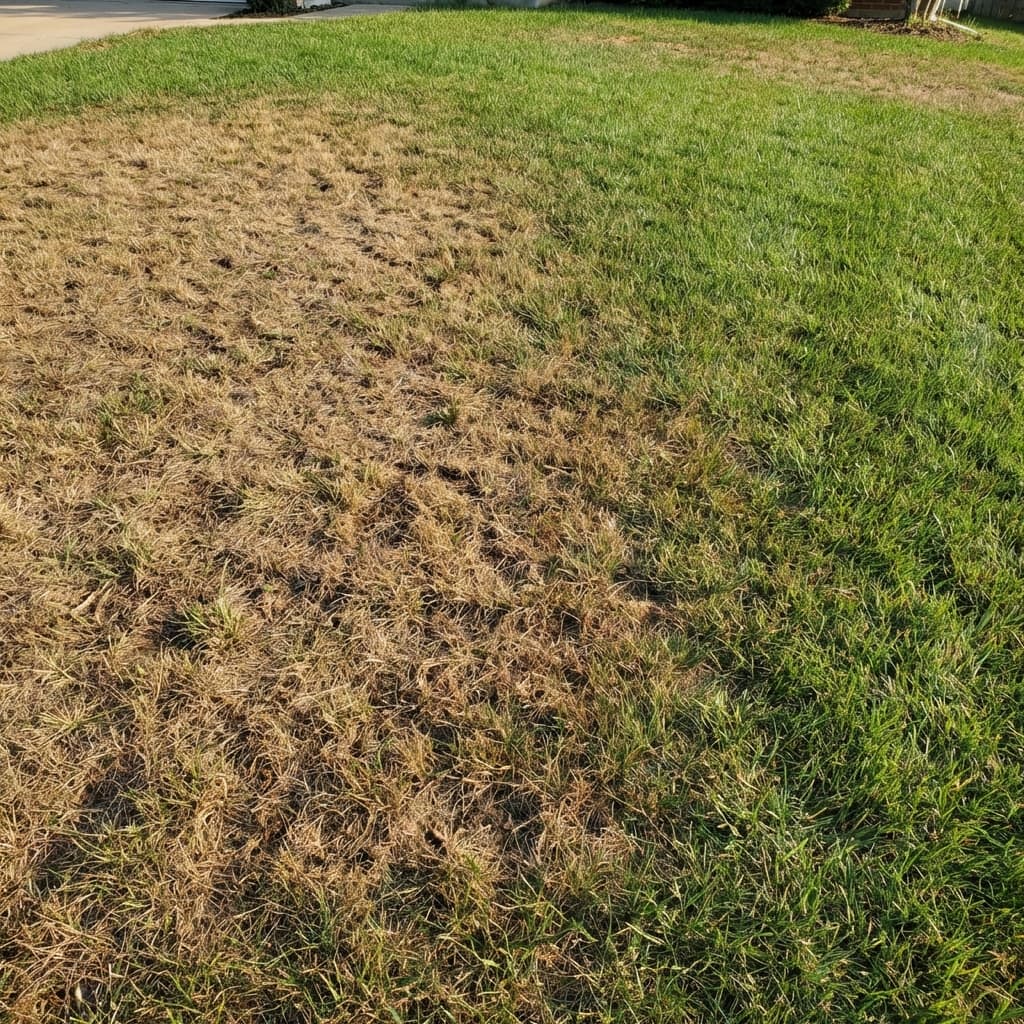
How to Fix Bare Spots in Your Jacksonville Lawn
Learn how to diagnose and repair bare spots in your Jacksonville lawn. Expert tips on causes like chinch bugs, fungus, and pet damage — plus step-by-step repair methods using sod plugs, patches, and reseeding for Zone 9a/9b.
Why Is My New Sod Turning Brown? Jacksonville Fix Guide
Troubleshoot and fix brown new sod in Jacksonville. Learn causes from underwatering to heat stress, diagnostic tests, and recovery solutions.
5 Signs Your Lawn Needs to Be Replaced (Not Just Repaired)
Is your lawn beyond saving? Learn when it makes more sense to start fresh with new sod instead of fighting a losing battle with repairs.
Let’s talk about your lawn
Ask our AI assistant a lawn question, or send the team a free installation estimate request.