37+ Years of Professional Sod Installation(904) 901-1457
Shade Grass Solutions for Jacksonville: What Actually Survives Under Your Oak Trees
October 12, 2024
10 min read
Sod Types

Shade Grass Solutions for Jacksonville: What Actually Survives Under Your Oak Trees

That beautiful live oak is killing your lawn. Learn which grass varieties handle Northeast Florida's shaded conditions and what alternatives exist when grass simply won't work.

Mature trees are among the most valuable assets a Jacksonville property can have. A century-old live oak adds tens of thousands of dollars to your home's value, provides cooling shade that cuts electricity bills, and creates that distinctively Southern aesthetic that defines our region's most beautiful neighborhoods.

But those same magnificent trees create a problem that frustrates homeowners across Northeast Florida: nothing grows underneath them. You water, fertilize, and reseed, yet the grass beneath your oak's canopy progressively thins, yellows, and eventually surrenders to bare dirt. Meanwhile, weeds seem to thrive in the same shade that kills your grass.

This isn't a mystery, and it's not your fault. It's basic plant biology colliding with the wrong lawn expectations. But there are solutions—both grass varieties that genuinely tolerate shade and alternative approaches for areas where no grass can survive.


Understanding What "Shade" Really Means

Before discussing solutions, we need to define the problem precisely. "Shade" isn't a single condition—it's a spectrum, and different points on that spectrum require different approaches.

Filtered Light (Dappled Shade)

Filtered light occurs beneath trees with open canopies or small leaves that allow sunlight to penetrate as moving spots throughout the day. Crape Myrtles, ornamental maples, and young oaks typically create filtered light. A lawn beneath these trees might receive the equivalent of four to five hours of direct sun, just distributed in dappled patterns rather than solid blocks.

This is the easiest shade condition to address. Most shade-tolerant grass varieties perform well in filtered light, and the primary challenge is managing root competition for water rather than light deprivation.

Partial Shade (Morning Sun, Afternoon Shade)

Partial shade describes areas that receive direct sunlight for part of the day and complete shade for the remainder. The classic example is the east side of a house, which gets morning sun until noon and sits in the building's shadow all afternoon.

Partial shade is workable for turf, especially if the sunny period coincides with morning hours when photosynthesis is most efficient. Morning sun with afternoon shade is significantly better than the reverse because afternoon sun is more intense and heat-stressful.

Dense Shade (Deep Canopy)

Dense shade is the most difficult condition. These are areas beneath mature live oaks or southern magnolias with thick, multi-layered canopy that blocks virtually all direct sun. Some light may reach the ground during winter when the sun angle is low, but from spring through fall, these areas receive less than two hours of direct sunlight.

Dense shade is problematic because even the most shade-tolerant grasses require some energy from sunlight to sustain themselves. Without adequate photosynthesis, the grass slowly depletes its carbohydrate reserves, thins progressively, and eventually dies—regardless of how well you water or fertilize.

💡 Know Your Shade: Measure sunlight hours before choosing grass. Less than 4 hours = shade grass only. Less than 2 hours = no grass will work.


Ranking the Shade-Tolerant Grasses

Not all grass varieties are equally suited to low-light conditions. Within each species, specific cultivars have been selected for improved shade performance. Here's how the common Florida options compare:

Tier 1: The Shade Champions

Palmetto St. Augustine

Palmetto is the gold standard for shade tolerance in Northeast Florida. Developed by the University of Florida, this dwarf St. Augustine variety maintains its color and density with as little as four hours of direct sunlight—significantly less than the six to eight hours required by Floratam.

Palmetto also offers advantages beyond shade tolerance. It holds its green color better during cool weather, when other St. Augustine varieties fade to yellow. It recovers quickly from water stress, displaying less permanent damage from drought periods. And its finer blade texture creates a more refined appearance than coarser varieties.

The tradeoffs are moderate: Palmetto is slower to establish than Floratam and slightly more susceptible to chinch bug damage. But for shaded applications, there's no better mainstream choice.

Seville St. Augustine

Seville matches Palmetto in shade tolerance and adds superior cold tolerance, maintaining green color into temperatures that would turn other varieties brown. Its blade is finer than even Palmetto, creating an almost manicured appearance.

Seville's primary limitation is availability. It's grown by fewer farms than Palmetto, which can mean longer lead times and higher prices. If you can source it, though, Seville is an excellent choice for shaded areas that also experience cold winter temperatures.

Tier 2: Moderate Shade Tolerance

CitraBlue St. Augustine

CitraBlue is a newer release from UF, selected for its distinctive blue-green color and lower fertilizer requirements. Its shade tolerance falls between Palmetto and Floratam—adequate for filtered light or partial shade, but not up to dense canopy conditions.

CitraBlue is a good compromise for yards with mixed conditions, where some areas get full sun and others receive moderate shade.

Empire Zoysia

Zoysia grass is often marketed as shade-tolerant, but the reality is more nuanced. Empire Zoysia handles partial shade reasonably well—it can maintain density with five to six hours of sun. However, in truly dense shade, Zoysia thins just like other species.

Zoysia's advantage in partially shaded areas is its traffic tolerance. Where St. Augustine would be damaged by foot traffic, Zoysia's deep root system allows it to bounce back. If you need a shaded lawn that also handles dogs, kids, or foot traffic, Zoysia with adequate light is worth considering.

Tier 3: Not Recommended for Shade

Floratam St. Augustine

Despite being the most commonly installed grass in Florida, Floratam is a poor choice for shade. It requires six to eight hours of direct sunlight and declines rapidly when those requirements aren't met. The vast majority of "my lawn has bare spots under the trees" problems trace back to Floratam planted in shade.

Bermuda Grass (All Varieties)

Bermuda is a full-sun grass with zero shade tolerance. Even filtered light causes Bermuda to thin and decline. Never plant Bermuda in areas that receive afternoon shade from buildings, fences, or trees.

Bahia Grass

Bahia handles drought and neglect but not shade. Its shade tolerance is minimal—comparable to Bermuda. Like Floratam, Bahia requires full sun exposure to maintain density.


The Sunlight Mapping Exercise

Before spending money on shade-tolerant sod, verify your actual light conditions. Perceptions of shade are often inaccurate—that "mostly shady" spot might receive more sun than you realize, or that "partial shade" area might be deep shade for most of the growing season.

Spend a day mapping sunlight in your yard. Every two hours from 8 AM to 6 PM, walk your property and note which areas are receiving direct sun, which are in dappled shade, and which are in full shadow. Mark your observations on a sketch of your yard.

Calculate the total hours of direct sun each area receives. Areas with four or more hours are candidates for Palmetto or Seville. Areas with two to four hours are marginal—shade grass might survive but will struggle. Areas with less than two hours of direct sun are too shaded for any lawn grass.

This mapping exercise also reveals seasonal variations. The summer sun is high and intense; the winter sun is low and weaker. Some areas that seem shady in summer receive significant sun in winter when deciduous trees drop leaves or the low sun angle reaches under canopy edges.

✅ The Light Test: Walk your property every 2 hours from 8 AM to 6 PM. Count total hours of direct sun in each zone. This 30-minute exercise prevents years of failed grass.


When Grass Won't Work: Alternative Groundcovers

In dense shade beneath mature oaks and magnolias, the honest answer is that no grass will thrive. Rather than investing in repeated sodding attempts that fail, consider alternatives designed for zero-sun conditions.

Asiatic Jasmine (Trachelospermum asiaticum)

Asiatic Jasmine is the workhorse groundcover for deep shade in Florida. It spreads by runners, forming a dense evergreen mat 6-8 inches tall. Once established, it requires minimal water or maintenance—just occasional edging to keep it in bounds and an annual "haircut" to remove old growth.

Asiatic Jasmine tolerates foot traffic reasonably well and suppresses weeds through its dense growth. It doesn't look like a lawn, but it provides complete green coverage where grass cannot survive.

Mondo Grass (Ophiopogon japonicus)

Mondo Grass creates a more formal, manicured appearance than Asiatic Jasmine. Its dark green blades grow in tidy clumps that can be mass-planted for complete coverage. Dwarf Mondo Grass stays only 2-4 inches tall, creating a lawn-like effect from a distance.

The tradeoff is cost and establishment time. Mondo Grass is typically planted from plugs or flats, which is labor-intensive for large areas. It also spreads slowly, taking two to three years to fill in completely.

Mulch and Shade Gardens

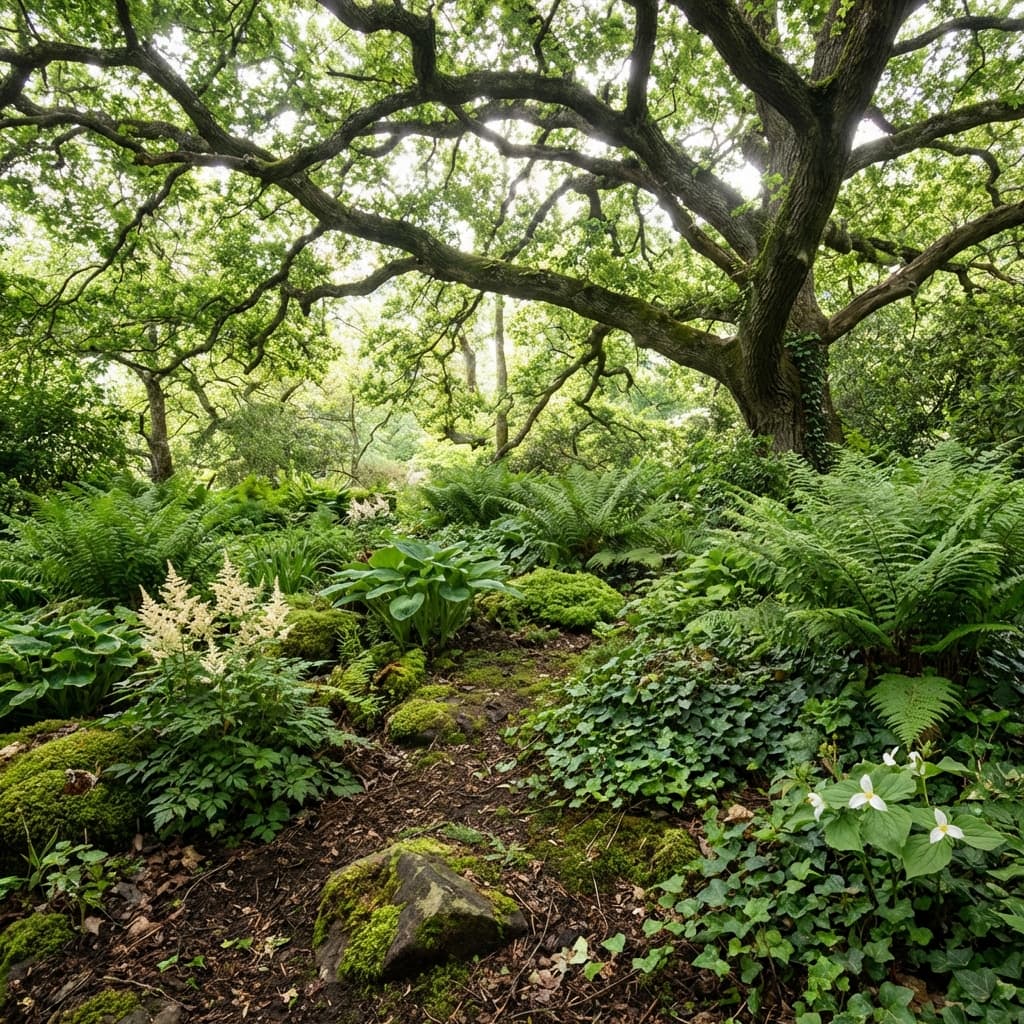
Sometimes the best solution is to stop fighting biology entirely. Convert deep shade areas into mulched planting beds featuring shade-tolerant shrubs, ferns, and groundcovers. This approach acknowledges that the area isn't suitable for lawn and transforms it into a different type of landscape feature.

Shade gardens can be beautiful when designed intentionally. Cast-iron plants, ferns, caladiums (for seasonal color), and low native shrubs create interest without requiring the sunlight that grass demands. A ring of mulched beds beneath a large oak looks planned and professional; bare dirt patches look neglected.


Improving Light Conditions

Rather than adapting to shade, sometimes you can reduce it. Strategic tree pruning—often called "limbing up" or "crown raising"—can dramatically increase the light reaching your lawn while preserving the tree's health and appearance.

Crown Raising

Crown raising involves removing lower branches to raise the canopy height. If a tree's lowest branches start at 6 feet, raising them to 10-12 feet opens a window of sky beneath the canopy. Morning and afternoon sun can penetrate under the branches, adding hours of direct light to shaded areas.

Crown raising should be done by a certified arborist who understands proper pruning cuts and branch collar preservation. Poor pruning techniques create wounds that invite disease and decay.

Crown Thinning

Crown thinning selectively removes interior branches to reduce canopy density without changing its overall shape or size. This allows more dappled light to reach the ground while maintaining the tree's silhouette and shade value.

Thinning typically removes 15-25% of the canopy's interior branches. Removing more risks stressing the tree; removing less may not provide meaningful light improvement.


FAQ: Shade Grass Questions

Q: Can I mix sun and shade grasses in the same lawn?

A: It's not recommended. Different grass varieties have different textures, colors, and growth rates. Where they meet, you'll have a visible line that looks like mismatched carpet patches. It's better to plant shade-tolerant grass throughout the entire lawn—Palmetto performs fine in full sun, it just doesn't demand it like Floratam does.

Q: Will "shade seed mix" work in my yard?

A: Shade seed mixes sold in Florida typically contain Fescue or Rye—cool-season grasses that don't survive our summers. They might establish and look good in fall or winter, then die when temperatures climb in May. This is not a viable permanent solution.

Q: My oak tree wasn't there when the lawn was installed, but now it shades the grass. What happened?

A: Trees grow. A young oak that provided minimal shade when you moved in might now have a 40-foot canopy. As shade increases, grass that once thrived begins to struggle. Your options are renovation with shade-tolerant varieties, tree pruning to increase light, or conversion to non-grass groundcovers.


Making the Right Decision

The key to success with shaded lawns is honesty about your conditions. Measure your actual light levels before selecting grass varieties. Recognize that some areas are simply too dark for any turf. And consider whether alternatives—groundcovers, mulch beds, hardscape—might produce a better long-term result than repeated failed attempts at grass.

Shade doesn't have to mean bare dirt. It means adjusting expectations and selecting the right plants—or non-plants—for the conditions you actually have.

🎯 The Honest Answer: Sometimes the best solution for deep shade isn't grass—it's Asiatic Jasmine, mulch beds, or a shade garden. Stop fighting biology.

Struggling with shade in your yard? Contact Jax Sod for a site evaluation. We'll measure your light conditions and recommend the best approach—whether that's shade-tolerant sod, groundcover conversion, or a combination.

Ready to Transform Your Lawn?

Stop guessing and start growing. Our team at Jax Sod has 37+ years of experience helping Jacksonville homeowners create the lawn of their dreams.